You’ve optimized your code, trimmed your libraries, and back-tested until your eyes crossed—yet your orders are still getting sniped at the finish line. In the ruthless world of high-frequency trading (HFT), “fast” is no longer a metric; it’s a moving target. If you aren’t fighting for nanoseconds in 2026, you aren’t just slow—you’re invisible. We’re pulling back the curtain on the hardware stack that separates the predators from the prey in today’s hyper-liquid markets.
1. Overclocked Bare-Metal| The Need for Sustained 6GHz+
In 2026, standard server CPUs are for the back office, not the trade floor. To stay competitive, you need “liquid-cooled, frequency-optimized” silicon. We aren’t talking about standard boost clocks; we are talking about specialized HFT hardware rigs from vendors like BlueScreaming or Equus that pin all cores to 6.0GHz or higher.
Why does this matter? Jitter is the silent killer of execution. When a CPU scales its frequency up and down to save power, it introduces micro-delays that cause your “tick-to-trade” latency to drift. By using liquid-chilled, bare-metal servers with C-states disabled, we ensure every instruction executes with the exact same deterministic speed. If your processor “blinks” to catch its breath, the market has already moved on.
2. FPGA Integration| Moving Logic to the Edge
If you’re still relying solely on a CPU to handle market data feeds, you’re bringing a knife to a railgun fight. Field Programmable Gate Arrays (FPGAs) have moved from “nice-to-have” to a mandatory requirement. These chips allow you to hard-code your trading logic directly into the hardware circuitry.
The modern low latency server now utilizes a hybrid architecture. The FPGA handles the heavy lifting—collecting, cleansing, and parsing the firehose of market data—before passing only the most critical signals to the CPU. This “kernel bypass” strategy means your data never even touches the traditional operating system. It’s like having a dedicated fast-lane on a highway that everyone else is stuck in traffic on.
3. The 800G Networking Revolution and SmartNICs
By mid-2026, the standard 10Gb and 40Gb handoffs feel like dial-up. Modern exchanges are pushing the limits, and your Network Interface Card (NIC) needs to be more than just a port. We are seeing a massive shift toward SmartNICs that support 400G and 800G throughput with sub-microsecond latency.
These aren’t your average Ethernet cards. A high-end SmartNIC in an HFT hardware setup performs on-card pre-processing. It can filter out “noise” from the feed before it ever hits your system RAM. Imagine a security guard who doesn’t just open the door, but also checks IDs and organizes the line so the guests can enter the room at a sprint. That is what a 2026-spec NIC does for your packets.
4. Precision Time Protocol (PTP) and Atomic Sync
In 2026, “close enough” isn’t a timestamp. Regulators and your own alpha-capture models demand nanosecond-level accuracy. This is where Precision Time Protocol (PTP) hardware comes in. You need dedicated Grandmaster Clocks synchronized via GPS or even local atomic oscillators.
Without a unified time-source across your low latency server cluster, your logs become a mess of “time-traveling” data where an exit order appears to happen before the entry. Expert tip: ensure your hardware supports hardware-based timestamping. If the timestamp is applied at the software level, it’s already too late. You need the “birth certificate” of that packet printed the moment it hits the wire.
5. Direct-to-Chip Liquid Cooling
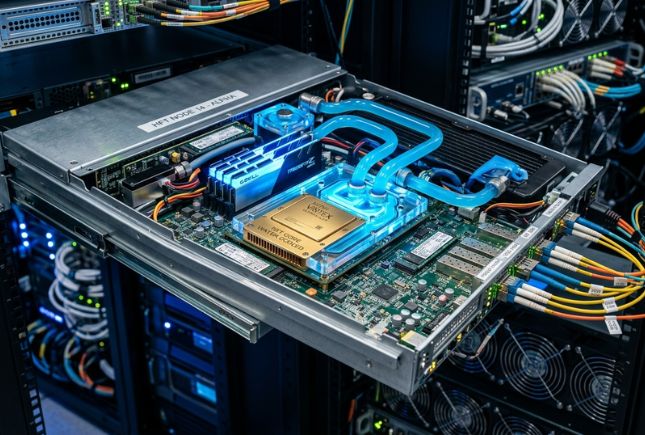
You cannot push silicon to 6.2GHz without a serious thermal strategy. In 2026, the roar of server fans is being replaced by the silent hum of coolant loops. Direct-to-chip liquid cooling is the new standard for HFT. It allows for extreme component density without the risk of thermal throttling.
We’ve seen firms pack 400W CPUs into 1U chassis that would melt in a traditional air-cooled rack. This allows you to stay co-located inside the exchange data center—where space is at a premium—without sacrificing raw horsepower. If your gear is running hot, your latency is drifting. Stay cool, or get liquidated.
Common HFT Hardware Queries (FAQ)
Can I use a standard cloud provider for HFT?
Generally, no. Most cloud providers use virtualization (VMs), which introduces “noisy neighbor” jitter. For true HFT, you need “bare-metal” where you have 100% control over the hardware.
Is AMD or Intel better for HFT in 2026?
It’s a toss-up. Intel’s latest Sapphire Rapids-AP chips offer incredible single-core bursts, while AMD’s EPYC “Zen 5” lines provide massive L3 cache which is vital for keeping data close to the cores.
What is the “Tick-to-Trade” goal in 2026?
For top-tier firms, the goal is sub-500 nanoseconds for the hardware round-trip. Every year, this window shrinks.
Do I really need an FPGA for a small trading firm?
If you are competing on price-arbitrage or market-making, yes. If you are doing “mid-frequency” (holding for minutes), you might get away with a highly optimized C++ stack on a fast CPU.
Is your rack ready for the 2026 volatility?
Don’t let your hardware be the bottleneck. Evaluate your thermal limits and networking stack today, or watch your fills disappear tomorrow!